Online coursesSep 24, 2026
Encyclopedia Deck Review
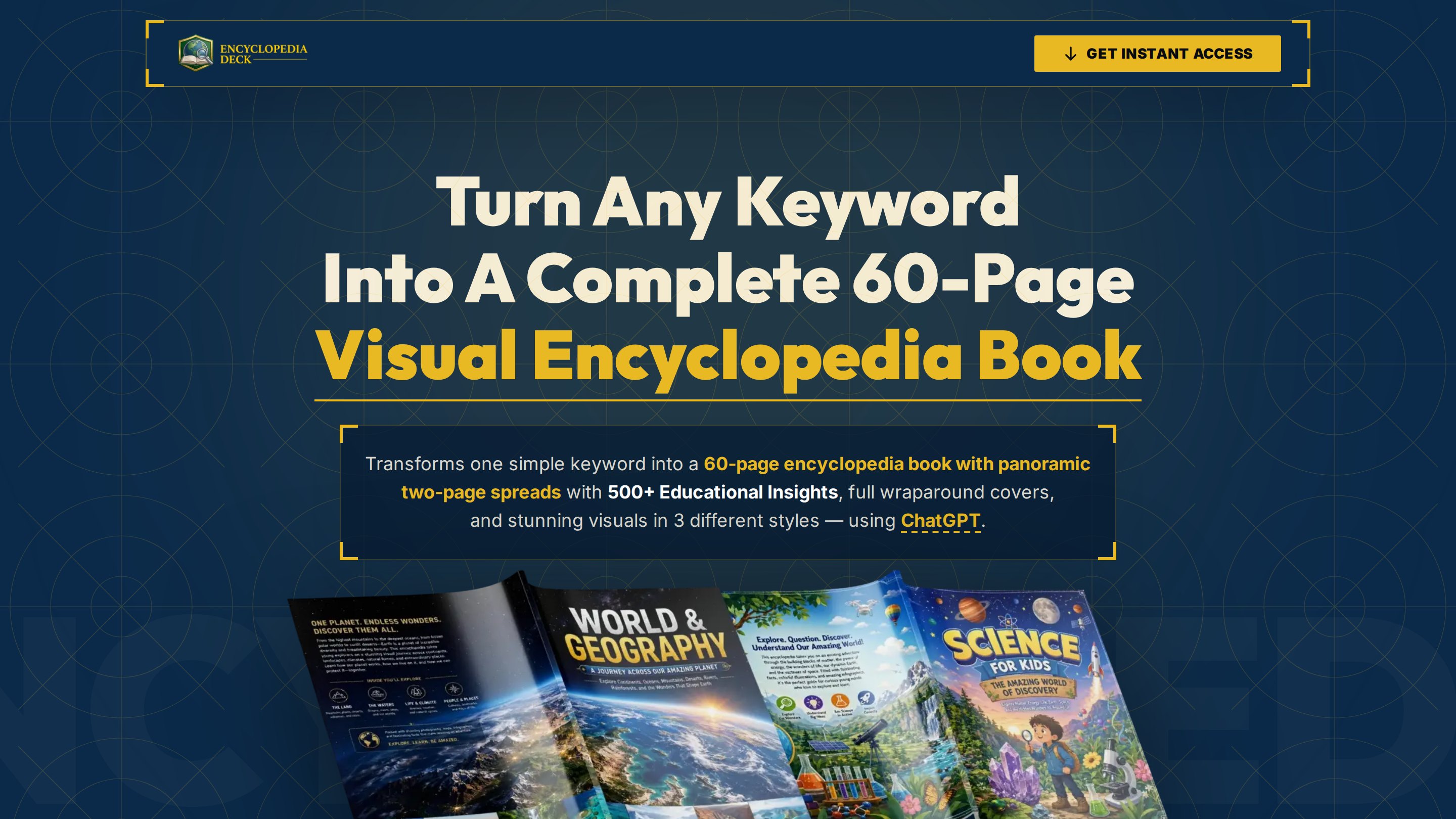
Encyclopedia Deck claims to turn any keyword into a complete 60-page visual encyclopedia using ChatGPT. It offers structured content, visual prompts, and multiple styles.
Strong buy
Encyclopedia Deck presents itself as a valuable tool for organizing AI-generated content and visuals into a structured encyclopedia format. It addresses a real pain point in content creation by providing a guided workflow for ChatGPT.
The good
- +Claims to automate the structuring of a 60-page visual encyclopedia, which is a complex task for AI tools alone.
- +Offers three distinct visual styles (realistic photography, cartoon/illustration, B&W outline art) with corresponding prompts, expanding creative possibilities.
- +Includes a PDF Combiner bonus to convert finished pages into a print-ready PDF, streamlining the publishing process.
- +Provides flexibility with both an 'Autopilot Mode' for quick generation and 'Manual Override' for detailed customization.
- +Claims to work in multiple languages, broadening its potential market.
The catch
- −Requires an active ChatGPT subscription, which is an additional cost not included in the purchase of Encyclopedia Deck.
- −The primary output is visual prompts and content briefs; users still need to generate the actual images using an AI image generator and manage the process.
- −The sales page heavily relies on hypothetical scenarios and estimations for potential earnings, rather than concrete case studies or user testimonials.
- −The 'exhibit gallery' shows images of finished products, but the extent of human intervention required to achieve that quality is not explicitly detailed.
What it claims Encyclopedia Deck claims to transform any keyword into a complete 60-page visual encyclopedia book with panoramic two-page spreads, 500+ educational insights, full wraparound covers, and stunning visuals in three different styles using ChatGPT. It states that it eliminates blank-page planning, manual spread structuring, and manual visual planning.
The tool claims to generate 30 structured panoramic spreads with 500+ educational facts, matching covers, 30 interior spreads, and back covers. It specifically creates visual prompts formatted for AI image generation and allows users to choose between Realistic Photography, Cartoon/Illustration, or B&W Educational Outline styles.
Users can opt for Auto Editorial mode or take control with Manual Config, customizing book size, cover style, inner style, colors, borders, text space, density, and information placement. A bonus 'Encyclopedia PDF Combiner' is claimed to turn panoramic spreads into a publication-ready PDF.
The sales page asserts that Encyclopedia Deck provides a guided workflow in four steps: picking a topic, using ready-made briefs for ChatGPT content, generating 30 panoramic scenes with precise visual prompts, and combining finished pages into a complete book within the app. It claims the AI builds the encyclopedia behind the scenes, offering total flexibility between speed (Autopilot Mode, optimized for kids) and precision (Manual Override for specific niches).
It states that it works in multiple languages, including English, Indonesian, Mandarin Chinese, Japanese, Spanish, French, Arabic, Russian, German, and Portuguese, among others. # Who it is for This tool is designed for individuals, creators, and publishers looking to quickly generate structured educational content, especially visual encyclopedias. This includes those interested in creating assets for Amazon KDP, Etsy digital products, homeschooling resources, classroom materials, PLR products, and printable educational books.
It is particularly aimed at users who want to leverage AI (specifically ChatGPT) for content generation but struggle with organizing and structuring that content into a cohesive, visually appealing book format. # The tradeoff Encyclopedia Deck offers a structured workflow to streamline the creation of visual encyclopedias, reducing the complexity of organizing AI-generated content. However, the tradeoff is that it's not a standalone, all-in-one solution.
While it provides the 'blueprint' and guidance, it explicitly states that it is not a graphic design application or a standalone AI generator. Users must have and use ChatGPT to generate the content and will still need to engage with an AI image generator to produce the actual visuals from the provided prompts.
This means the user is still responsible for the active generation of both text and images, even if guided by the tool, and potentially for iterating on those generations to achieve the desired quality. The bonus PDF Combiner helps finalize the product, but the core creation still relies on external AI tools and user input to drive those tools.